
Executive Summary
Durga Puja is no longer simply a religious festival. It has evolved into one of India's largest cultural, consumer, tourism, retail and marketing ecosystems. The 2024 edition was particularly significant because it unfolded against an unusually difficult backdrop. Protests following the RG Kar incident, rain, floods and weaker consumer sentiment affected pre-Puja shopping and corporate sponsorships.
Industry estimates subsequently put Bengal's 2024 Puja economy at approximately ₹42,000 crore — down roughly 20–30% from the stronger preceding period. Yet the scale remained enormous. Kolkata recorded 2,905 Puja committees in 2024, up from 2,757 in 2023, while reported committee budgets ranged from roughly ₹15 lakh to ₹1 crore-plus, with corporate sponsorships identified as a major funding source.
For brands, this represents something far more valuable than conventional outdoor advertising: millions of consumers physically moving through branded environments while simultaneously shopping, eating, travelling, creating content and participating in one of India's strongest cultural moments.
Durga Puja 2024 at a Glance: Key Numbers
| Indicator | 2024 Picture |
|---|---|
| Estimated Bengal Puja economy | ~₹42,000 Crore |
| Previous benchmark (2023) | ~₹50,000 Crore |
| Previous retail benchmark | ~₹33,000 Crore |
| Kolkata Puja committees | 2,905 |
| Kolkata committees in 2023 | 2,757 |
| Kolkata "big" pujas identified by police | 248 |
| Typical reported committee budgets | ₹15 lakh – ₹1 Crore+ |
| Estimated sponsorship reduction (some segments) | 25–35% |
| Six-day Kolkata airport traffic during Puja | ~4 lakh flyers |
The ₹42,000-crore figure is a retrospective 2024 estimate reported later by industry sources; the ₹50,000-crore figure was the benchmark being cited before/during the 2024 season. These should not be treated as contradictory audited accounts.
Understanding the ₹42,000 Crore Economy
The most important mistake brands can make is to think of the Puja economy as pandal expenditure. The actual ecosystem is much larger, encompassing:
- Consumer spending: apparel, footwear, jewellery, electronics, home appliances, beauty, gifts, fashion, food, restaurants, sweets, entertainment.
- Festival production: idol making, pandal construction, decoration, lighting, sound, electrical work, printing, fabrication, security, crowd management.
- Marketing: sponsorship, outdoor advertising, pandal branding, transit advertising, digital marketing, influencer campaigns, experiential marketing, sampling, retail activation.
- Travel & tourism: air travel, rail, hotels, cabs, bus services, restaurants, tourist experiences.
- Services & logistics: transport, warehousing, delivery, installation, event staffing, photography, videography, content production.
The British Council's earlier creative-economy research identified Durga Puja as a major economic ecosystem spanning creative industries, tourism, retail, food, logistics, advertising and related sectors. Its 2019 study estimated the broader Durga Puja creative economy at approximately ₹32,377 crore — equivalent to 2.58% of West Bengal's GDP at the time.
The Trajectory: 2019 to 2025
2019: ~₹32,377 Cr (historical baseline) | 2023 benchmark: ~₹50,000 Cr | 2024 estimate: ~₹42,000 Cr. The drop in 2024 should not be seen as a failure of the festival economy, but rather as a result of the unusual social and economic conditions during that time.
Why 2024 Was a Difficult Year for Brands
2024 was an unusual year. The RG Kar incident led to long protests in Kolkata and across Bengal, which created a tense social environment just before the festival. This had a direct impact on businesses: brands became more careful, consumers delayed their purchases, sponsors reconsidered their commitments, and outdoor ad spaces were booked more slowly.
According to Exchange4Media, some brands cut their Puja marketing budgets by 25 to 35%. Those that did advertise focused more on emotions, honesty, and social awareness, rather than just celebrating the festival with glamour.
Business Standard also reported mixed results for sponsorships: Singhi Park’s sponsorship reportedly dropped by around 25%, while Bagbazar Sarbojanin’s reportedly increased by about 20%. Some big brands from outside Kolkata were still visible, but last-minute confirmations caused some issues with how campaigns were executed.
The lesson for 2026 is that the best Puja campaigns aren’t necessarily the ones with the biggest budgets — they are the ones that are most relevant to the current situation.
Kolkata: The Core Consumer Marketplace
Kolkata had 2,905 registered Puja committees in 2024, compared with 2,757 in 2023 — an increase of approximately 148 committees, or +5.4%. Of these, 248 were identified as "big" pujas by Kolkata Police.
This is strategically important: a brand does not need to advertise at all 2,905 locations. Instead, marketers can build a Puja audience hierarchy.
The Puja Audience Hierarchy (Tier 1–5)
This is essentially a media network disguised as a cultural festival.
The Crowd Economy: How People Actually Move Through Durga Puja
There is another reason Durga Puja is so attractive to brands: people move. A television viewer stays in one location. A digital user scrolls. But a Puja visitor travels through an entire ecosystem — for example: Home → Metro → Taxi → Pandal → Food → Shopping → Another Pandal → Café/Restaurant → Social Media → Home.
Every movement generates potential consumer touchpoints, which is why a single pandal gate can have value far beyond its physical dimensions. The visitor may see the brand, photograph it, stand beside it, share it, discuss it, search it, visit it, and ultimately purchase from it — a shift from static banner visibility toward immersive experiences: gates, LED, activation zones and digital amplification.
Travel & Logistics: How Durga Puja Pulls Consumers Into Kolkata
The festival also operates as a tourism engine. Kolkata airport handled approximately 4 lakh flyers over the six principal Puja days in 2024, demonstrating the scale of travel demand generated around the festival. Aviation is only one component — visitors also arrive by rail, intercity buses, private cars, taxis and app-based mobility.
They then spend on hotels, restaurants, shopping, local transportation, entertainment, tourism and pandal-hopping. A consumer travelling into Kolkata is already entering an economically active festival environment — making this audience especially valuable for hospitality, travel, automotive, mobility, financial services and consumer brands.
Top 10 High-Visibility Puja Pandals in Kolkata 2024
Rather than simply calling these the "10 best pandals," we present them as 10 High-Visibility Consumer & Brand Environments of Kolkata 2024. The selection is based on the overlap of contemporary 2024 coverage, cultural prominence, theme visibility and visitor interest — it is not an audited footfall ranking.
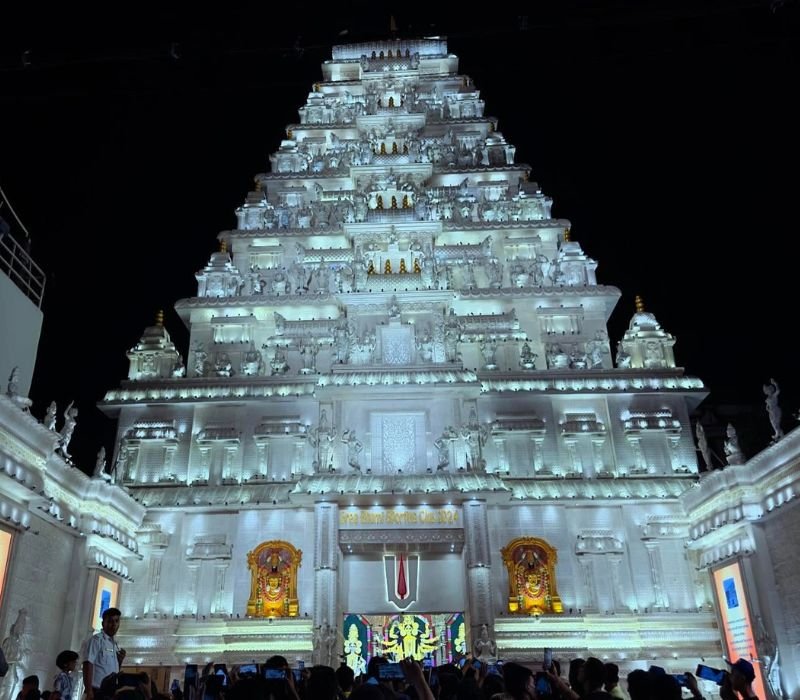
Sreebhumi Sporting Club
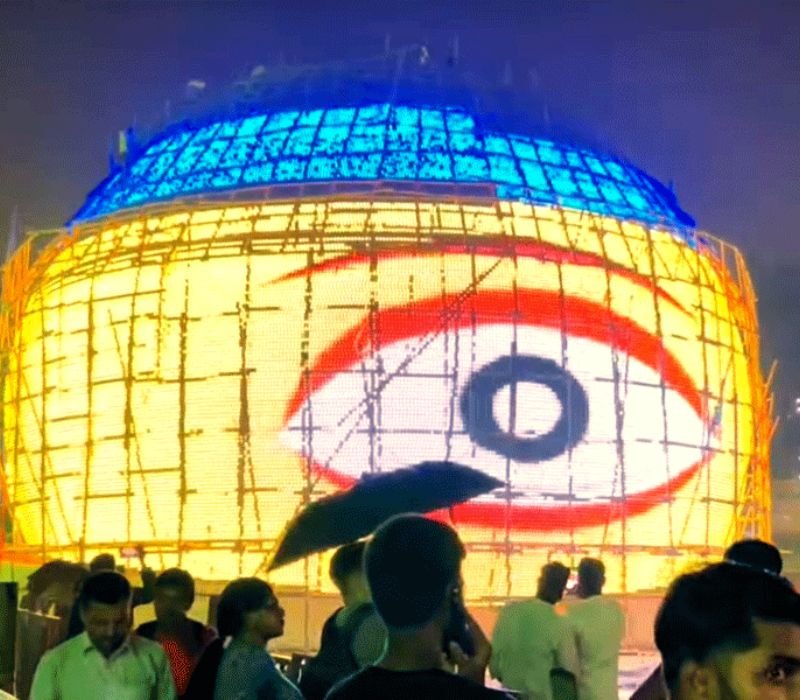
Santosh Mitra Square
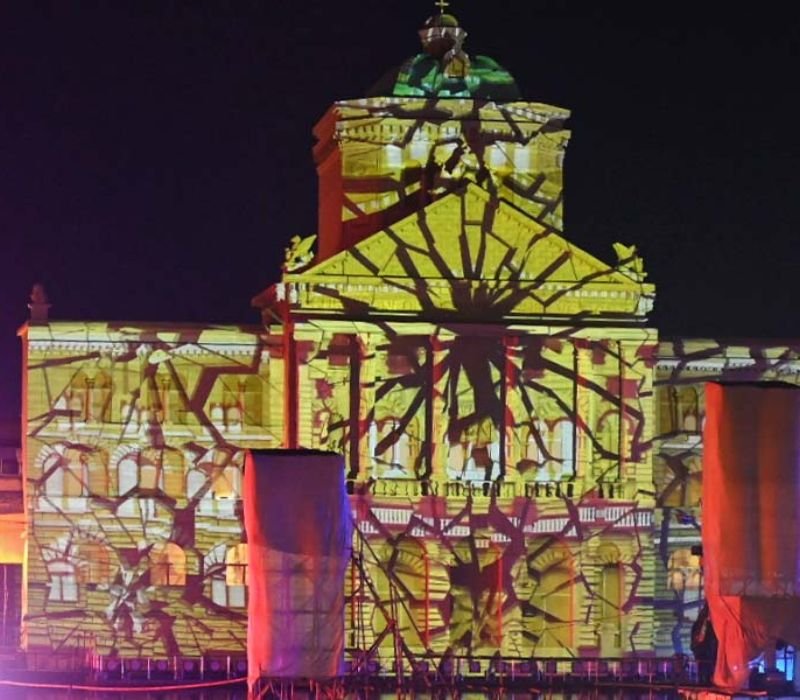
College Square
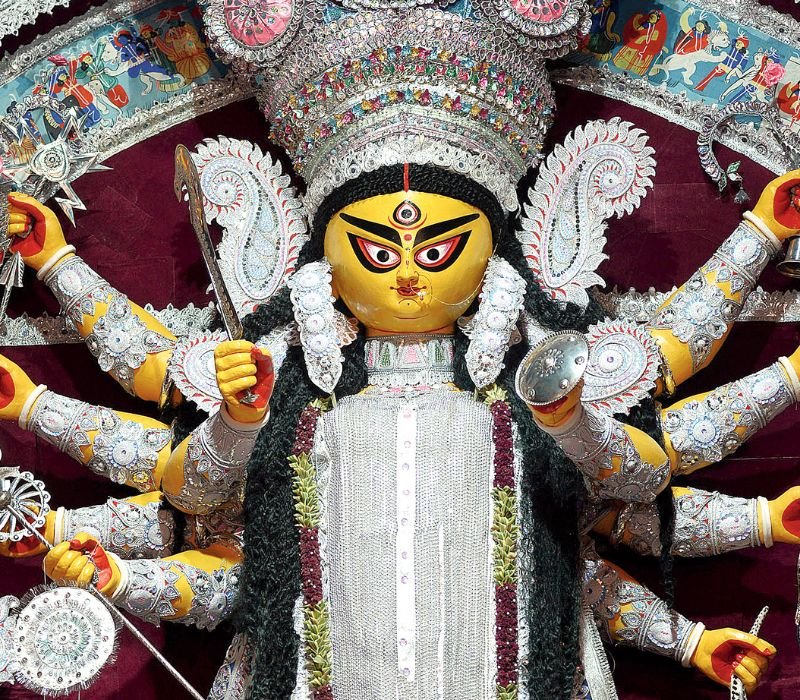
Bagbazar Sarbojanin
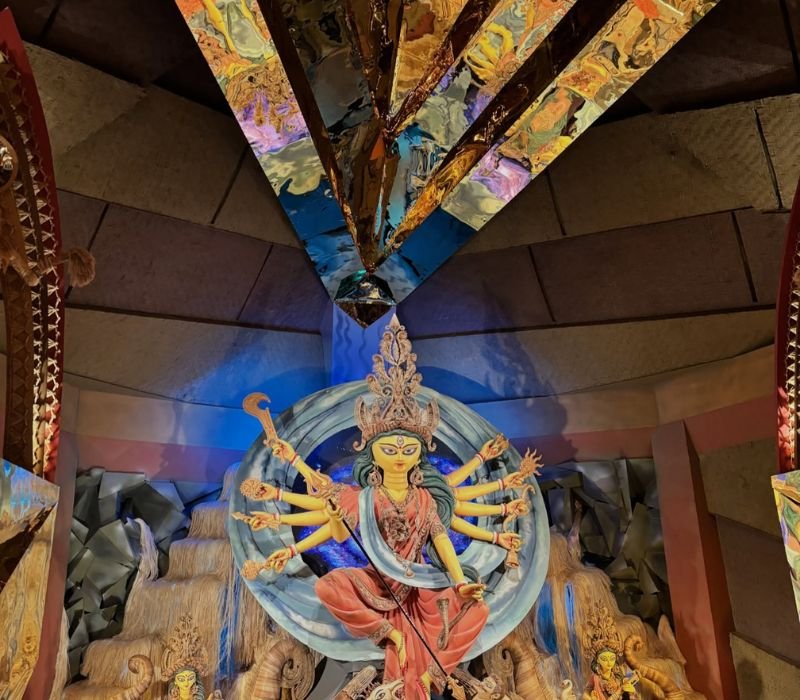
Chetla Agrani
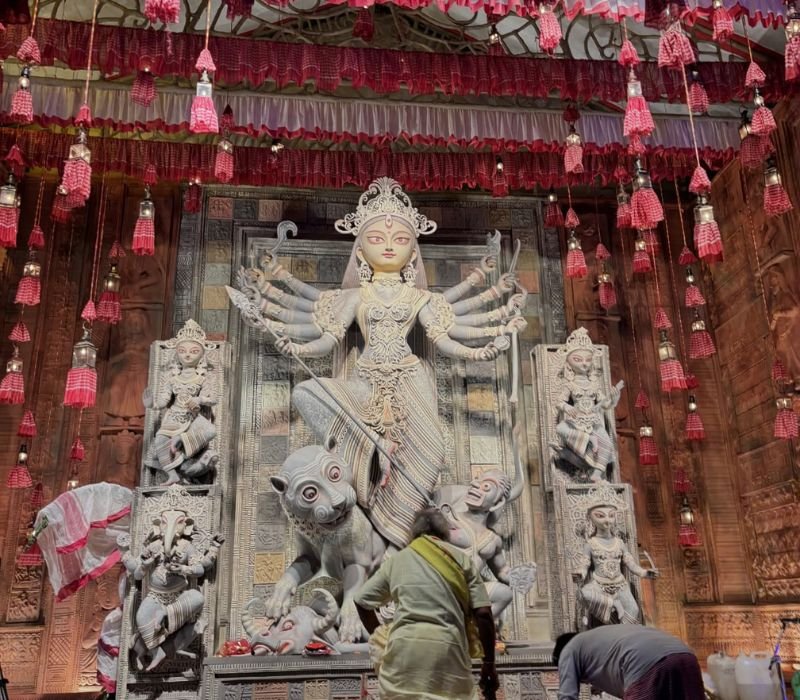
Suruchi Sangha

Jodhpur Park
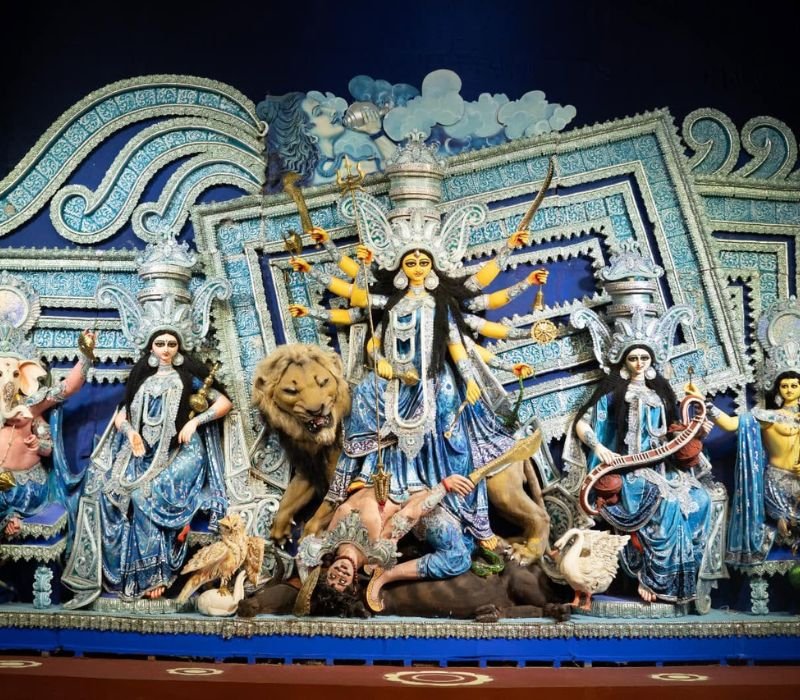
Deshapriya Park
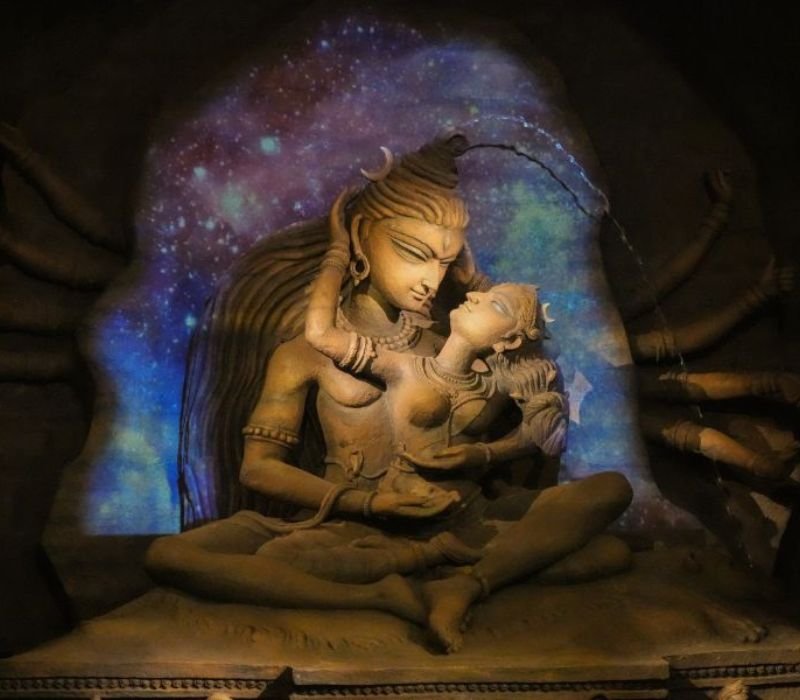
Dum Dum Park
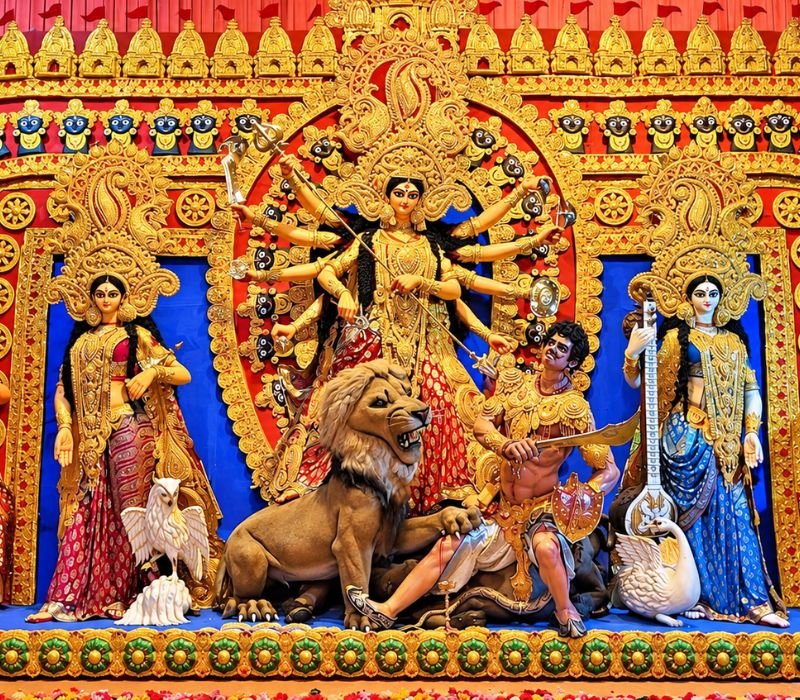
Ekdalia Evergreen
Industry-Wise Advertiser Map
The most interesting feature of Durga Puja marketing is that almost every consumer-facing category can find a relevant moment.
| Industry | Typical Puja Objective | Strongest Formats |
|---|---|---|
| FMCG | Awareness + sampling | Pandal + activation |
| Jewellery | Premium association | Gate + idol/heritage |
| Fashion | Festive purchase | OOH + retail |
| Electronics | Product discovery | LED + experience |
| Automotive | Premium positioning | Pandal + OOH |
| Banking | Trust + acquisition | Pandal + kiosk |
| Insurance | Family protection | Community activation |
| Healthcare | Trust + service | Health camp |
| Food & Beverage | Trial + impulse | Sampling + kiosk |
| Real Estate | Lead generation | OOH + digital |
| Cement/Steel | Corporate visibility | Gates + OOH |
| Telecom/Technology | Youth engagement | LED + digital |
| E-commerce | Conversion | Digital + OOH |
| Hospitality | Tourism | Airport + digital |
| Travel | Destination marketing | Transit + digital |
| Beauty | Consumer trial | Activation |
| Education | Local awareness | OOH + digital |
Industry reporting around the 2024 season specifically described advertising activity across cement, TMT bars, fashion, supermarkets, food, real estate, beverages and jewellery, in addition to more traditional large consumer brands.
Which Businesses and Industries Advertised During Durga Puja 2024
The broader Puja advertising ecosystem has historically attracted brands including:
| Industry | Examples of Participating Brands |
|---|---|
| FMCG | Hindustan Unilever (HUL), Dabur, food & beverage companies |
| Jewellery | Senco Gold & Diamonds, regional/national jewellery houses |
| Fashion & Retail | Bata, Sreeleathers, Tata CLiQ, supermarkets, fashion retailers |
| Technology | Electronics brands, smartphone companies, consumer-durable brands |
| Finance | State Bank of India (SBI), private banks, insurance companies, fintechs |
| Infrastructure | Steel, cement, TMT, electrical & building-material companies |
| Food & Beverage | Beverage companies (e.g. Campa), packaged food, restaurants, QSRs, sweets |
| Healthcare/FMCG | GSK |
Important: for a corporate-facing report, specific pandal-brand relationships such as Senco Gold & Diamonds, Campa, Tata CLiQ, SBI, HUL and GSK at particular 2024 pandal environments should be described as "reported/illustrative associations" unless independently documented by the brand, committee or a reliable contemporaneous source.
The Marketing-Spend Question: What Brands Actually Invested in 2024
This is the section where most Puja reports become unreliable — there is no consolidated, audited public database showing total Durga Puja advertising spend in Kolkata. So instead of inventing a precise number, we use an estimated market model.
Historical industry reporting has put corporate Puja advertising at several hundred crores, with earlier estimates of approximately ₹500–800 crore in corporate spending and around ₹150 crore associated with banners/gates. Those are historical benchmarks, not audited 2024 figures. Meanwhile, 2024 industry reporting suggested that some brands reduced marketing expenditure by 25–35%.
Our Recommended 2024 Planning Model
If we use the ₹42,000 crore estimated festival economy as the economic base, a hypothetical marketing-intensity range of 2–4% would imply:
| Scenario | Marketing Intensity | Implied Ecosystem Value |
|---|---|---|
| Conservative | 2% | ₹840 Crore |
| Base | 3% | ₹1,260 Crore |
| High | 4% | ₹1,680 Crore |
These are analytical scenarios, NOT reported 2024 expenditure. They are useful for planning and sales strategy, but should be labelled as an analytical estimate based on reported festival-economy data and historical advertising benchmarks — a distinction that protects the credibility of the report.
How a ₹1,000+ Crore Marketing Ecosystem Could Be Distributed
For strategic planning, the broader brand-marketing ecosystem can be modelled at scale — this is not saying brands actually spent these exact amounts, but it demonstrates how a large-scale Puja campaign could be structured across the entire consumer journey.
This reframes the commercial conversation from "How much is one gate?" to "How do we allocate ₹50 lakh, ₹1 crore or ₹5 crore across the entire Puja consumer journey?" — a planning model, not an audited 2024 expenditure figure.
Illustrative Allocation Model
What Does a Pandal Branding Investment Actually Buy?
A Puja branding package typically spans several distinct touchpoints across the visitor's physical journey:
- Entry — Main gate / overhead gate: the first major branded touchpoint
- Queue — Branding where consumers spend significant time waiting
- Interior — LED / standee / wall / experiential branding
- Exit — One of the most powerful moments, as visitors are often relaxed and taking photographs
- Surrounding roads — OOH, directional branding and approach-road visibility
- Activation — Consumer interaction
- Sampling — Physical product trial
- Digital — Social amplification
- Influencer — Content creation
This reflects the broader industry shift from simple gate branding to integrated OOH, LED, experiential and digital formats.
Consumer Spending: The Retail Engine
The pre-2024 benchmark estimated approximately ₹33,000 crore of retail business connected with the Puja period, covering apparel, footwear, appliances, furnishings, gadgets and publishing.
This is strategically important because it means brands can use Puja advertising for two very different objectives — a brand objective ("Remember us") and a business objective ("Buy from us"). The strongest 2026 campaigns should connect the two.
The Pandal-to-Purchase Funnel
This is where traditional Puja branding becomes performance marketing.
See
Consumer sees the brand at the pandal.Experience
Consumer interacts with the brand.Share
Consumer photographs / posts / reels.Search
Consumer searches the product/service.Visit
Consumer visits website/store.Convert
Consumer purchases / enquires.Retarget
Brand reconnects digitally.Why 2024 Matters for 2026
There is an important strategic lesson hidden inside the 2024 numbers. 2024 was a difficult year — yet Puja committees increased, major pandals remained highly visible, brands continued participating, outstation travel remained significant, retail remained central, digital content around pandals exploded, and corporate sponsorship remained a major funding source.
Therefore, the underlying platform remained strong despite the temporary slowdown. 2025 reporting subsequently showed a rebound in the Puja economy, with estimates again moving into the ₹46,000–50,000 crore range in one major industry assessment — creating a compelling bridge toward 2026.
The 2026 Opportunity: Own a Cultural Moment
Why should large brands invest in Durga Puja 2026? Because the opportunity is no longer "buy an advertisement" — it is to own a cultural moment. A brand can build a city-wide campaign around:
- Premium Pandal Association — Own the most culturally relevant locations
- Citywide OOH — Connect multiple pandal clusters
- Transit — Own the journey into and across Kolkata
- Experiential — Allow consumers to touch, test, taste or experience the brand
- Digital — Turn physical presence into social content
- Influencers — Let creators become brand ambassadors
- Retail — Convert attention into purchase
- Data — Capture leads, enquiries, registrations or consumer interactions
The 2026 Brand Architecture (4 Layers)
Own 5–10 premium pandals for high visibility and cultural association.
Own strategic OOH corridors to create geographical continuity.
Create 5–10 experiential zones that give consumers a reason to interact.
Use digital, influencer and social content to turn the physical campaign into millions of digital impressions.
Example ₹1 Crore 2026 Campaign
This is where the report becomes commercially useful for budget planning.
| Activity | Indicative Allocation |
|---|---|
| Premium pandal branding | ₹30 L |
| OOH / transit | ₹20 L |
| Experiential activation | ₹15 L |
| Digital advertising | ₹12 L |
| Influencer/content | ₹8 L |
| Production/fabrication | ₹7 L |
| Retail activation | ₹5 L |
| Measurement/contingency | ₹3 L |
| Total | ₹1 Cr |
This is an illustrative planning model, not a market-rate quotation. The exact budget would depend heavily on committee, location, inventory, duration, exclusivity, fabrication and campaign objectives.
What a-one box Can Offer
Rather than positioning a-one box merely as an advertising vendor, we recommend presenting it as a Durga Puja Brand Experience & Marketing Partner, offering:
- Strategy — Identify the right audience and locations
- Pandal Partnerships — Negotiate with relevant Puja committees
- Creative — Develop campaign concepts around the Puja environment
- Production — Gate, structure, LED, banners, kiosks and fabrication
- Activation — Consumer engagement and experiential marketing
- OOH — Connect individual pandals into a citywide network
- Digital — Amplify physical visibility
- Content — Photography, video, reels and influencer content
- Reporting — Campaign photographs, location reports, activation documentation and post-campaign reporting
The New Definition of Puja Marketing
Traditional model: Logo + Banner + Gate
Modern model: Pandal + OOH + Experience + Digital + Content + Retail
2026 model: Audience + Location + Experience + Content + Data + Conversion
That is the evolution brands need to understand.
The 2024 → 2026 Strategic Journey
| Year | Milestone | Estimated Value |
|---|---|---|
| 2019 | Structural creative economy | ~₹32,377 Cr |
| 2023 | Large-scale commercial expansion | ~₹50,000 Cr |
| 2024 | Temporary disruption + resilience | ~₹42,000 Cr |
| 2025 | Recovery | ~₹46,000–50,000 Cr |
| 2026 | Opportunity for strategic brand investment | Projected growth |
Selected published estimates and benchmarks. Values represent different reporting periods and should be read as directional rather than as a continuous audited series. The important story isn't simply that 2024 was lower — it's a five-stage arc: 2019 structural creative economy → 2023 large-scale commercial expansion → 2024 temporary disruption and resilience → 2025 recovery → 2026 opportunity for strategic brand investment.
The Biggest Lessons From 2024
- Lesson 1 — Cultural relevance matters
- Lesson 2 — Premium locations matter more than excessive inventory
- Lesson 3 — Physical branding alone is no longer sufficient
- Lesson 4 — Digital amplification multiplies physical investment
- Lesson 5 — Timing matters
- Lesson 6 — Committee relationships matter
- Lesson 7 — Experiential campaigns create stronger engagement than passive branding
- Lesson 8 — Puja should be planned as a 360° campaign, not a five-day media buy
Top committees are often negotiated months ahead, and successful campaigns integrate pandal presence with digital, OOH and other media.
Why Brands Should Start Planning Durga Puja 2026 Now
Premium inventory is limited. Premium pandals are limited. Premium dates are limited. Premium audience segments are limited. And competing brands are already studying the same locations.
The question for 2026 isn't: "Should our brand advertise during Durga Puja?". It should be: "What part of the Durga Puja consumer journey should our brand own?".
Final Perspective
Durga Puja 2024 proved that Kolkata's festival economy is far bigger than the pandal. It is a sophisticated ecosystem connecting culture, consumers, retail, tourism, transportation, food, hospitality, entertainment, advertising, experiential marketing and digital commerce.
Even in a difficult 2024 environment, the estimated festival economy remained around ₹42,000 crore. And the number becomes even more meaningful when we understand what sits behind it: thousands of committees, hundreds of major pujas, millions of consumer journeys, thousands of businesses, thousands of temporary workers, hundreds of brands, and an extraordinary concentration of consumer attention.
That is what makes Durga Puja one of India's most powerful festival-marketing platforms. For brands looking toward Durga Puja 2026, the opportunity is no longer simply to place a logo at a pandal — it is to create a campaign that consumers see, experience, photograph, share, search for and ultimately remember.
That is the future of Durga Puja marketing in Kolkata.